Tuesday, June 30, 2015

USA launch vehicle redundancy


Very interesting article in today's Wall Street Journal written by Willie.  J. Webb


By 

William Shelton 

June 29, 2015 7:07 p.m. ET 

The explosion of an unmanned SpaceX rocket after liftoff at Cape Canaveral in Florida on Sunday was a graphic reminder of why U.S. national space policy requires that there be two independent means of launching satellites for national-security missions: in case one launch system fails. 

SpaceX, headed by Elon Musk, is contracted to resupply the International Space Station. Critics who are unhappy about the use of Russian rocket engines for national-security launches have campaigned to get SpaceX involved in those missions. But the failure of its Falcon 9 version 1.1 rocket should give everyone pause about jettisoning a dependable arrangement vital to U.S. security. 

Current U.S. space policy is implemented by buying both the Atlas V and Delta IV rockets from the United Launch Alliance, a joint venture of Lockheed Martin and Boeing. BA 0.46 % Both rockets have a 100% success record—83 launches without failure.

Yet Congress is on the verge of passing legislation—the fiscal 2016 National Defense Authorization Act—that will put U.S. space policy at considerable risk.

The problem arose last year from attacks on United Launch Alliance as a monopoly and for using Russian-made engines on its rockets. These criticisms ignore why the two companies, with the government's blessing, formed a joint venture in 2005. There was simply not enough business to sustain two domestic launch companies. 

Today the Atlas V lofts two-thirds of all national-security satellites. The first stage of the rocket is powered by the Russian-produced RD-180 engine. The U.S. government encouraged Lockheed Martin to use this engine primarily because of its performance and relatively low cost. There was also a desire to keep Russian rocket scientists at work for us, and not on projects for other countries perhaps less friendly to the U.S. 

Still, the U.S. Air Force does seek to lower launch costs, and an important part of its plan is to get new entrants into the rocket business. Today several companies are attempting to do just that. But before any new company can compete for national-security launch contracts, it must pass a rigorous certification process to ensure its rocket or rockets are reliable.

SpaceX is the first company to complete the certification process for its Falcon 9 Version 1.1 rocket—the one that failed on Sunday. But the company is also developing a "Full Thrust" Falcon 9—capable of carrying all but the heaviest satellites—and that is the rocket it intends to use to bid on national-security contracts. 

The Falcon 9 Full Thrust version hasn't gone through certification, indeed it has never been launched. Nevertheless, SpaceX lobbyists last year convinced key congressional leaders that their rocket is ready to launch national-security missions. The company's criticism of United Launch Alliance and its Russian-produced RD-180 engines—including a widely publicized antitrust lawsuit it filed in April 2014 (then withdrawn in January)—played very well on Capitol Hill and in public opinion.

As a result, the fiscal 2015 National Defense Authorization Act, which became law last December, banned using the Russian-made RD-180 beyond the remaining few engines already under contract. The purported rationale is to uphold Russian sanctions and avoid rewarding the country's bad behavior in Ukraine and elsewhere. 

Fair enough: It is smart policy to seek an alternative to a supplier based in a more bellicose Russia. But an abrupt ban is not smart. The Air Force has a more cautious transition plan—which would not curtail the RD-180 until there are two certified alternatives—but congressional action is causing that plan to unravel. 

The December legislation also mandated that a new American rocket engine be ready by 2019. United Launch Alliance has announced that it will develop a new engine, and a new rocket, to replace the Atlas V, and will do so on time. Many experts are dubious about this timetable. Yet even if United Launch Alliance can meet the deadline, it will run out of RD-180 engines well before its new rocket is ready. United Launch Alliance has also announced that it will stop production of its far more expensive Delta IV (with the exception of a variant that can lift the heaviest U.S. satellites). 

Therein lies the risk. Once United Launch Alliance runs out of RD-180 engines and Delta IV production stops, the only available rocket for most payloads will be SpaceX's uncertified Falcon 9 Full Thrust. The long-standing national space policy to ensure two means of access to space for national security satellites will be ended, essentially by congressional fiat. 

As a boss taught me long ago, the first rule of wing walking is to never let go until you have a firm grasp on the next handhold. Yet our pique at Russia, coupled with effective lobbying, has resulted in legislation that is tantamount to letting go. 

In April the House of Representatives passed a new, slightly revised fiscal 2016 National Defense Authorization Act. It contains a clause that allows the secretary of defense to waive the ban on the RD-180 for as long as needed if the secretary deems it in the national interest to do so. The Senate's version, passed on June 18, limits the waiver to a maximum of nine engines, thereby ensuring the elimination of the Atlas V from competition. 

The House and Senate bills will be reconciled in the near future. It is up to the senior leadership of the Armed Services Committees and a conference committee to protect U.S. national security by ensuring that we always have more than one reliable rocket to launch all of our military satellites. 

Gen. Shelton, who is retired from the U.S. Air Force, was the commander of Air Force Space Command from January 2011 to August 2014.


Sent from my iPad

More False Memories About the Origin (and Cost) of SLS - NASA Watch

Facts on nasaproblems.com
http://nasawatch.com/archives/2015/06/more-false-memo.html


Sent from my iPad

Should be conducting operations in Earth Orbit AND in Moon bases. FEAR of CHINA!!

So here we are, can't get cargo to ISS, no manned capabilities, have to use Russian engines for some of our critical launches. Have a administrator who flew shuttle 3 times, but will not support lifting body/ runway lander, & will not EVEN fund our inferior capsule approach which will not be successfully manned for another decade, if we are lucky!
As Jeffs of RI stated, will take FEAR of China to get our capabilities back-----
HOPE IT IS NOT TOO LATE!!!!

Sent from my iPad

SpaceX rocket failure raises questions about space station's vital supplies - Orlando Sentinel

Remember what Kraft, Krantz, Abbey said about keeping shuttle until replacement available!! IDIOTS IN DC!
http://www.orlandosentinel.com/business/la-fi-spacex-fallout-20150629-story.html


Sent from my iPad

Do you really think we will be a leading space faring Nation with the " on the cheap" commercial approach?

Below is a summary by a friend at nasa that sums up the "space on the cheap approach".

.... unfortunately unlike any of our past programs where we still had a say on how the vehicle is to be built plus a degree of oversight, we ( nasa) are now basically cut off from these COTS vehicles. The quality of work ranges from excellent to down right horrible! Some like Boeing have vast experience, follows much the same processes that they have been using with us and even comes up with quite a bit of product (and process) innovation and improvements of their own. Others just hires people (like Draper labs) who knows what they are doing. Finally we got the ones who hires fresh out college kids, pays them low wages and promises them dreams and uses threats to build their vehicles. We get what we pay for ....

Monday, June 29, 2015

Fwd: NASA honors fallen astronauts, lost shuttles


Sent from my iPad

Begin forwarded message:

From: "Gary Johnson" <gjohnson144@comcast.net>
Date: June 29, 2015 at 3:19:04 PM CDT
To: "Gary Johnson" <gjohnson144@comcast.net>
Subject: FW: NASA honors fallen astronauts, lost shuttles


 June 27, 2015


'Forever Remembered' Shares Enduring Lessons of Challenger, Columbia

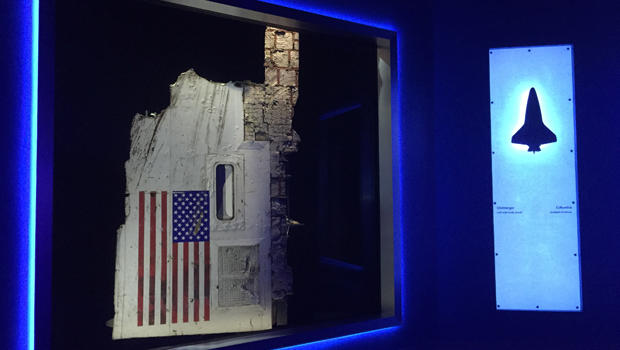
A section of the fuselage recovered from shuttle Challenger and the flight deck windows recovered from shuttle Columbia

A section of the fuselage recovered from space shuttle Challenger, left, and the flight deck windows recovered from space shuttle Columbia are part of a new, permanent memorial, "Forever Remembered," opening June 27 in the Space Shuttle Atlantis exhibit at the Kennedy Space Center Visitor Complex in Florida.

Credits: NASA/Kim Shiflett

Artifacts representing Ronald McNair, who served as a mission specialist on space shuttle mission STS-51L, are displayed

Artifacts representing Ronald McNair, who served as a mission specialist on space shuttle mission STS-51L, are displayed in a new, permanent memorial, "Forever Remembered," in the Space Shuttle Atlantis exhibit at the Kennedy Space Center Visitor Complex in Florida.

Credits: NASA/Kim Shiflett

Artifacts representing Ilan Ramon, who served as payload specialist on space shuttle mission STS-107, are displayed

Ilan Ramon, payload specialist on space shuttle mission STS-107, is remembered through artifacts and personal items in the new "Forever Remembered" memorial.

Credits: NASA/Kim Shiflett

By Anna Heiney
NASA's Kennedy Space Center, Florida

The Space Shuttle Program story is full of spectacular successes. From its maiden voyage in 1981 to its final touchdown in 2011, the capable, reusable delta-winged vehicle captivated a generation. Teams of astronauts pulled off seemingly impossible feats in Earth orbit while a cast of thousands supported them from the ground.

But the shuttle story also includes the losses of 14 courageous astronauts and the nation's first two shuttles, Columbia and Challenger. The tragedies galvanized the agency to learn from these painful events, not only to safely return the shuttle fleet to flight, but to help assure the safety of future explorers.

NASA and the astronauts' families have collaborated to create a new, permanent memorial designed to honor the crews, pay tribute to the spacecraft and emphasize the importance of learning from the past. "Forever Remembered" opened today at the Kennedy Space Center Visitor Complex in Florida, where it completes NASA's 30-year Space Shuttle Program told throughout the Space Shuttle Atlantis exhibit.

Encompassing nearly 2,000 square feet, the memorial contains the largest collection of personal items of both flight crews. It also includes recovered hardware from both Challenger and Columbia, never before on display for viewing by the public.

Family members were present at a small ceremony Saturday as the memorial was formally opened by NASA Administrator Charles Bolden and Kennedy Space Center Director Bob Cabana, both veteran shuttle astronauts.

"The crews of Challenger and Columbia are forever a part of a story that is ongoing," Bolden said. "It is the story of humankind's evolving journey into space, the unknown, and the outer-reaches of knowledge, discovery and possibility. It is a story of hope."

Temperatures at Kennedy Space Center were just a few degrees above freezing on the morning of Jan. 28, 1986, as Challenger lifted off on its 10th mission, STS-51L. One minute and 13 seconds into the flight, a booster failure caused an explosion that destroyed the vehicle, resulting in the loss of the crew of seven astronauts: Commander Francis Scobee, Pilot Michael Smith, Mission Specialists Judith Resnik, Ellison Onizuka and Ronald McNair, and Payload Specialists Gregory Jarvis and Christa McAuliffe, a New Hampshire schoolteacher.

Seventeen years later, on Jan. 16, 2003, NASA's flagship orbiter Columbia thundered into orbit on STS-107, a 16-day science mission. On board were Commander Rick Husband, Pilot Willie McCool, Payload Commander Michael Anderson, Mission Specialists Kalpana Chawla, David Brown and Laurel Clark, and Payload Specialist Ilan Ramon, Israel's first astronaut. On Feb. 1, 2003, the orbiter broke apart in the skies above east Texas as it re-entered Earth's atmosphere on the way to a planned landing at Kennedy. Seven more lives were lost.

"I believe that it's important to share this story with everyone, and not just push it aside, or try to hide it," Cabana said. "These crews and these vehicles are part of who we are as an agency, and a nation. They tell the story of our never ending quest to explore, and our undying spirit to never give up."

"Forever Remembered" is designed to be an emotional experience, according to NASA's Mike Ciannilli, who has been NASA's lead on the memorial project since it began about four years ago. At the time, Ciannilli was a NASA Test Director and Landing Recovery Director.

"Emotion is timeless," Ciannilli explained. "It's important that we don't lock this experience into a certain time, a certain place."

"I knew it would be very emotional to see, but honestly, I didn't expect to be so impacted by it. I just can't stop thinking about it. As you walk in, you know you're in a special place," Evelyn Husband Thompson said of the memorial. Her husband, Rick, commanded Columbia on STS-107.

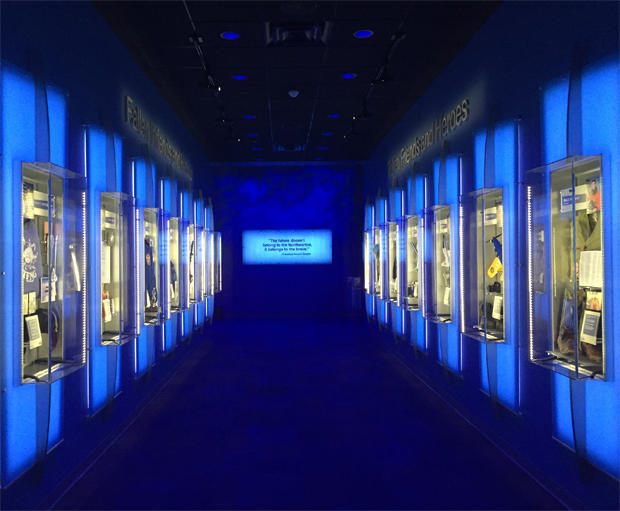
Visitors enter the memorial through a doorway flanked by the STS-51L and STS-107 mission patches. The orbiter and crew are remembered through individual collections lining the walls: Challenger on the left, Columbia on the right. The items were carefully chosen to share each astronaut's passions, talents and achievements, allowing their personalities to shine through.

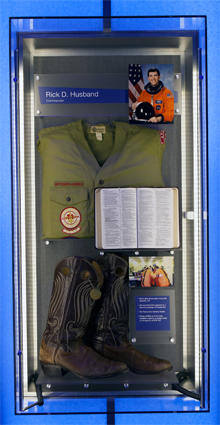
Husband's cowboy boots and Bible. A small aircraft Smith hand-carved for his wife. Anderson's vintage Star Trek lunch box. A research paper authored by Judy Resnik, displayed alongside sheet music for violin and piano. There are flight jackets, family photographs and numerous other artifacts offering a glimpse into the people behind the names on the mission patches. Many items were loaned by the families; others belong to NASA.

"The families have been unbelievably gracious, inspiring, warm and giving," Ciannilli said. "There were times they provided comfort to me as I worked on this, and still do."

At the end of the first hall, the warmth of the astronauts' collections gives way to a small gallery where guests will see firsthand the toll these events took on the shuttle hardware. A section of Challenger's fuselage displaying the American flag stands at left; on the right, the flight deck windows of Columbia are placed at eye level.

"When I look into those windows, I see John Young and Bob Crippen preparing to launch on the boldest test flight in history, the first flight of America's space shuttle, Columbia," Cabana said.

"I see a much younger Bob Cabana launching to space on his first command, and I see Rick and Willie and the rest of the 107 crew smiling and experiencing the wonders of space on the final flight of Columbia."

While great care has been taken to preserve the pieces, they're real, bearing the scars of the trauma each shuttle endured.

"It's a beautiful remembrance of all the shuttles, with the marvelous display of Atlantis. Nothing compares to it in the world," said June Scobee Rodgers, whose husband, Dick Scobee, commanded Challenger on STS-51L. "But Challenger and Columbia are not forgotten, and they're well represented."

But that is not where the story ends.

"Forever Remembered" concludes with a focus on the recovery and return-to-flight efforts, including the emotional toll these events had on the nation, the challenges involved in recovery, and the triumph of return to flight. A looping video shares heartfelt letters written by children as they shared their condolences and messages of hope.

After each loss, investigators spent months looking at recovered hardware, poring over data and conducting analysis to determine what had gone wrong. A second video reveals rarely seen photos and footage of this painstaking process.

The space shuttle team pulled together to fix the problems and return the program to flight each time. Any less effort would not have honored the fallen astronauts or their missions. Shuttle Atlantis, on display nearby, flew the final mission of the Space Shuttle Program, STS-135.

That determined spirit is alive in every launch. In a sense, every flight is a return to flight -- another opportunity to build upon success and experience.

"The artifacts here on display are not easy to look at. Many of them are on display for the very first time," Bolden said. "It is our hope that by making them available for the public to view, we will help remind the world, that every launch, every discovery, every measure of progress, is possible only because of the sacrifice of those we have lost."

Among McAuliffe's artifacts is a quote: "I touch the future. I teach."

The lessons of Challenger and Columbia will endure as we continue to reach for the stars.

Last Updated: June 27, 2015

Editor: Anna Heiney


Inline image 2


By William Harwood
CBS News
June 27, 2015, 10:53 AM

NASA honors fallen astronauts, lost shuttles

A section of the shuttle Challenger's fuselage is on display at a memorial honoring the crews of Challenger and Columbia at the Kennedy Space Center.

William Harwood/CBS News


In the first memorial of its kind, NASA and the families of the 14 men and women who lost their lives aboard the shuttle Challenger in 1986 and Columbia in 2003 have joined together to remember the astronauts with pictures, personal mementos and, in an emotional first, iconic wreckage from both orbiters.

The "Forever Remembered" memorial at the Kennedy Space Center's commercially operated Visitor Complex opened to the public Saturday after private viewings Thursday and Friday by family members.

"The crews of Challenger and Columbia are forever a part of a story that is ongoing," NASA Administrator Charles Bolden said in a statement. "It is the story of humankind's evolving journey into space, the unknown, and the outer-reaches of knowledge, discovery and possibility. It is a story of hope."

In the shadow of the shuttle Atlantis, mounted as if in flight in an open split-level building, the new memorial strives to strike a balance between sober reflection and a celebration of the crew members' lives and the vehicles that carried them aloft.

Challenger's crew -- commander Francis "Dick" Scobee, pilot Michael Smith, Ellison Onizuka, Judith Resnik, Ronald McNair, satellite engineer Gregory Jarvis and New Hampshire teacher Christa McAuliffe -- was killed when the shuttle broke up 73 seconds after liftoff on Jan. 28, 1986, because of a rupture in one of its solid-fuel boosters.

Columbia's crew -- commander Rick Husband, pilot William "Willie" McCool, David Brown, Kalpana Chawla, Michael Anderson, Laurel Clark and Israeli flier Ilan Ramon -- died during re-entry on Feb. 1, 2003, victims of wing damage caused by falling foam insulation during launch 16 days earlier.

The memorial features a central hallway with displays on both walls honoring each crew member, including personal items provided by their families.

shuttlehall2.jpg

The astronauts who lost their lives aboard the shuttles Challenger and Columbia are remembered at a new memorial at the Kennedy Space Center that features personal items donated by the families.

William Harwood/CBS News

Husband's Bible and Tony Lama cowboy boots can be seen, along with a house plan drawn up by Smith, a research paper written by Resnik, a "Star Trek" lunchbox and Cub Scout shirt once worn by Anderson and a charred page from Ramon's flight notebook, recovered after the accident.

Other mementos include Scobee's slide rule-like navigation computer and a leather flight helmet, Onizuka's personal Buddhist prayer beads, a biking trophy won by Jarvis and a copy of "Jonathan Livingston Seagull," one of Chawla's favorite books.

A photograph in Husband's display shows Columbia's crew, dressed in bright orange pressure suits, huddling for a group prayer before heading to the launch pad. In his Bible, the deeply religious shuttle commander had underlined Proverbs 5:6: "Trust in the Lord with all your heart and lean not on your own understanding; in all your ways submit to him, and he will make your paths straight."

"This was very important to me and very important to the people who work here at KSC," Kennedy Space Center Director Robert Cabana, a veteran shuttle commander, told CBS News during a pre-opening walkthrough Thursday. "Challenger and Columbia, they're part of our history, they're part of who we are as a nation and as an agency.

"And I think it's important to share that part of the story with everyone. It is part of who we are. It needs to be shared."

husband.jpg

Columbia commander Rick Husband's Bible, cowboy boots and scout shirt were donated to a new Kennedy Space Center memorial honoring the astronauts who perished in the Challenger and Columbia disasters.

NASA

At the end of the hall, a quote from President Ronald Reagan hangs on the wall: "The future doesn't belong to the fainthearted, it belongs to the brave."

Turning to the right, visitors enter a larger, darker room. On one wall, in a starkly lit display, is a large section of the torn, heavily damaged outer skin of Challenger's fuselage, still showing the American flag and an open vent door.

The recovered debris of Challenger has been stored for nearly three decades in two abandoned Minuteman missile silos at the Cape Canaveral Air Force Station. The wreckage shown at the memorial is the first debris from Challenger to be publicly displayed since the accident investigation was concluded in 1986.

Columbia is represented by the orbiter's six forward cockpit window frames, arranged as they were when still part of the orbiter. The glass is gone, of course, and the frames are discolored and clearly damaged. But they retain their iconic shapes and are instantly recognizable.

"They say the eyes are the windows to the soul," Cabana said, choking back tears. "And I think that's true of Columbia also. They're the windows to the soul of Columbia. And when I look at that, I see (astronauts) John Young and Bob Crippen on the first flight of Columbia. I see a young Bob Cabana on his first command. And I see Rick and Willie and the whole 107 crew, with smiles on their faces, enjoying that space flight."

For many workers at the Florida spaceport, NASA's shuttles -- Columbia, Challenger, Discovery, Atlantis and Endeavour -- were engineering marvels at the pinnacle of human achievement, each with its own "personality." And many space workers have voiced frustration over the years that the public never fully appreciated what an achievement the orbiters represented.

While the three surviving shuttles can be visited in museums, Cabana said adding wreckage from Challenger and Columbia brings closure, of a sort, to the thousands of men and women who maintained, serviced and launched NASA's fleet of space shuttles.

"The exhibit, it's not just a memorial to the crews, it is a memorial to the vehicles, to the entire KSC team," Cabana said. "The crews were part of our family, and the vehicles, they're part of our family, too."

columbiacrew.jpg

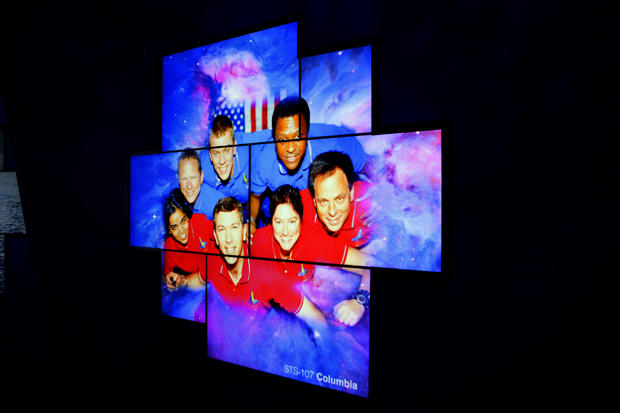
The shuttle Columbia's crew, floating together for a group portrait aboard the orbiter, in a photo recovered after the accident. Left to right (blue shirts): David Brown, William McCool and Michael Anderson. Left to right (red shirts): Kalpana Chawla, commander Rick Husband, Laurel Clark and Ilan Ramon. The image is shown as part of a multi-media display in a new memorial honoring the crews of Columbia and Challenger.

NASA

A final room in the memorial features three multi-screen high-definition video displays. One shows samples of cards and letters sent to NASA in the wake of the accidents. One child wrote: "I know being an astronaut is dangerous. But they were brave enough to follow their dreams."

A second display chronicles NASA's recovery from the two disasters, including the collection and analysis of debris. The third display highlights the "return to flight" missions that followed Challenger and Columbia after lengthy investigations.

More than a million tourists visit the KSC Visitor Complex each year, and Cabana said he hopes the shuttle memorial, along with the Atlantis display and other historical artifacts, will give the public a better appreciation of NASA's winged orbiters and the 14 men and women who lost their lives on the high frontier.

"It's our history. It's about perseverance. It's about rising above adversity," Cabana said. "It's about the vehicles, the crews and the NASA family that made it all possible. We're not going to forget the lessons that we learned. We're not going to forget the crews or the people who made it possible. ... This is an important part of that story that needs to be shared."

© 2015 CBS Interactive Inc. All Rights Reserved.