Sunday, December 6, 2015

Lost in space by Abbey --- highlights from Washington Examiner

SCROLL DOWN FOR NEXT STORY

Lost in space

This year is a banner year for marking anniversaries of achievements in space. The first walk in space was 50 years ago in March, and 40 years ago this month, the Apollo-Soyuz mission brought two Cold War adversaries together.

We can look back with pride on our achievements in space, but we should look ahead with concern for the uncertain future of America's human spaceflight program.

We should have a policy built on past activities and on a vision that doesn't change as administrations come and go. But we don't have one.

RELATED: WEX Podcast: Lost in Space — The vast emptiness of America's space vision

More from the Washington Examiner

The Hubble Space Telescope makes the point. Twenty-five years ago, on April 25, the space shuttle Discovery put the Hubble into orbit around Earth. In its quarter century of star gazing, Hubble has significantly altered the world's perception of the cosmos and furthered humankind's understanding of the universe. It has revealed previously unattainable properties of space and time. It is a unique scientific facility that continues to provide new views of the heavens and opens the door to discoveries.

But Hubble is more than just an outstanding science facility. It is living testimony to the value of humans in space and an incredible example of how humans and robotics can complement each other to achieve spectacular results.

Space shuttles have taken 355 people to space. Since their demise in 2011, the United States has been unable to put people into space except on other nations' spacecraft. It's a capability the U.S. has had since Alan Shepard's flight on May 5, 1961. The U.S. went from flying and operating the most advanced and capable spacecraft in the world, to flying as passengers under foreign command. Americans continue to journey to space on Soyuz spacecraft, but we are no longer able to work on facilities such as Hubble, or assemble large structures in space. We will look back on the space shuttle one day and realize what the nation lost, or rather, what it gave up.

America is not building a second-generation space shuttle but is instead building three space capsules: the Orion and two others, from Boeing and SpaceX. All will land by parachute, like spacecraft of the 1960s, and none will allow space walks comparable to the space shuttle. Unlike Hubble, the next big telescope, the James Webb Space Telescope (due for launch October 2018) will have to be right the first time. There will be no way to repair it. It is already more costly than originally planned, and there is no shuttle to take astronauts to save it if something goes wrong.

The U.S. Air Force's Boeing X-37B, which began as a NASA craft but was transferred to the Pentagon in 2004, is an unmanned space plane that looks like a small space shuttle. Like the shuttle, it returns to Earth and lands on a runway. It has been flying successfully for five years. A scaled-up version with an astronaut crew to work outside the vehicle could reestablish America's ability to build and maintain big structures in Earth orbit.

Sent from my iPad

Saturday, December 5, 2015

Total LUNACY ------ policy towards muslims & space capabilities!!

Destruction of America well underway---- look at treatment of muslims, & the maintenance of a safe AMERICA .

Destruction of military & space capabilities is part of this lunacy!!

Sent from my iPad

Fwd: SpaceX aims to resume Falcon 9 flights in mid-December


Sent from my iPad

Begin forwarded message:

From: "Gary Johnson" <gjohnson144@comcast.net>
Date: December 3, 2015 at 8:19:21 AM CST
To: "Gary Johnson" <gjohnson144@comcast.net>
Subject: FW: SpaceX aims to resume Falcon 9 flights in mid-December


SpaceX aims to resume Falcon 9 flights in mid-December

December 2, 2015 by Stephen Clark

16856277485_46ee89fef1_z

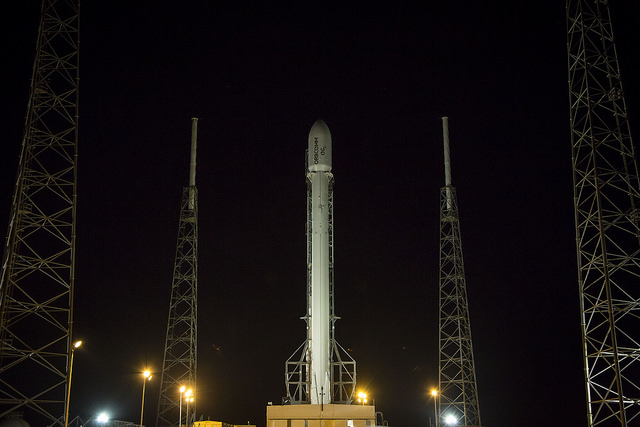
File photo of SpaceX's Falcon 9 rocket before launch of its first mission for Orbcomm in July 2014. Credit: SpaceX

SpaceX has shipped to Cape Canaveral the first Falcon 9 booster equipped with upgrades to haul heavier cargoes to orbit, aiming for a mid-December launch in the space transport company's first mission since a June rocket failure grounded the Falcon 9.

A cluster of communications satellites for Orbcomm, which operates a fleet of spacecraft in low Earth orbit to track ships, corporate assets and relay messages, is being prepared for the flight.

The launch could occur as soon as around Dec. 15, according to Marc Eisenberg, Orbcomm's chief executive. A launch Dec. 15 would occur around 10 p.m. EST (0200 GMT on Dec. 16), sources said.

But the target launch date is not official, and SpaceX must first connect the pieces of the rocket together and complete a ground-firing of the rocket's nine first stage engines on the launch pad in Florida.

Orbcomm in late October began shipping its 11 satellites slated to ride the Falcon 9 to orbit from their factory at Sierra Nevada Corp. in Colorado to the Florida spaceport. The Falcon 9's first stage arrived at Cape Canaveral in November, and the second stage is to be delivered this week after leaving SpaceX's Central Texas test site, Eisenberg said.

Stage 1 arrives at the cape. pic.twitter.com/Vq9CPysebv

— Marc Eisenberg (@Marc944Marc) November 20, 2015

The mission is crucial for SpaceX.

It is both the Falcon 9's return-to-flight launch and the inaugural voyage of an up-rated version of the launcher, an upgrade that was already planned before a June 28 rocket failure that destroyed a Dragon supply ship bound for the International Space Station.

SpaceX blamed the accident on a weakened structural brace inside the second stage's liquid oxygen tank. The component was not built to specification by a SpaceX subcontractor, officials said, and it fractured minutes after launch from Cape Canaveral, causing a high-pressure helium reservoir to break loose inside the oxygen tank, leading to the break-up of the booster.

On the upgraded — or "full-thrust" — Falcon 9, the rocket's nine Merlin 1D engines will generate additional power, topping out at more than 1.5 million pounds of thrust at sea level. Each of the first stage engines will provide 170,000 pounds of sea level thrust.

That is up from 147,000 pounds of sea level thrust per first stage engine on previous Falcon 9 flights.

A space-rated Merlin engine on the upper stage will have a maximum 210,000 pounds of thrust in vacuum, and it features a lengthened nozzle and extended tanks. The interstage connecting the Falcon 9's first and second stages is also changed to accommodate the new Merlin vacuum nozzle, which has a center pusher to aid stage separation, according to space industry officials.

The design modifications increase the rocket's height by about 5 feet — to 229 feet — and boost the Falcon 9's performance by about 30 percent, officials said.

The upgrades allow the Falcon 9 to lift heavier communications satellites into geostationary transfer orbit, and still have enough reserve propellant to attempt a landing of its first stage booster.

A NASA official told reporters Tuesday that SpaceX planned to recover the first stage from its next Falcon 9 launch on a landing pad at Cape Canaveral Air Force Station, bypassing another try to guide the rocket to an offshore barge like on previous landing attempts.

"Their plan is to try to land (the next booster) out here on the Cape-side," said Carol Scott from NASA's commercial crew program, according to a report published by Florida Today.

Scott cited a SpaceX executive in her comments, Florida Today reported.

SpaceX declined comment on the plan, but Elon Musk, the company's chief executive and founder, said on Twitter last week that SpaceX's experiments with rocket reusability, an achievement he says would drastically slash the cost of spaceflight, would continue after a rival company nailed a vertical landing of a suborbital launcher.

Blue Origin, backed by Amazon.com's Jeff Bezos, launched a rocket just beyond 62 miles (100 kilometers), the internationally-recognized boundary of space, and to a speed of Mach 3 before returning the booster to a successful landing.

The touchdown made Blue Origin's New Shepard rocket the first commercially-developed vehicle to take off under its own power, fly into space and return to Earth safely.

SpaceX's launch profile is vastly different than Blue Origin's, and Musk argued on Twitter that landing a Falcon 9 first stage booster — an objective not yet achieved by SpaceX — may be more difficult than recovering a rocket like the one flown by Bezos' company.

"Jeff maybe unaware SpaceX suborbital VTOL flight began 2013," Musk tweeted. "Orbital water landing 2014. Orbital land landing next."

In any case, a bid to return the Falcon 9 rocket to a landing facility leased by SpaceX from the U.S. Air Force will require approvals from the Federal Aviation Administration and the Air Force-run range at Cape Canaveral.

And it is not clear if the regulatory and safety agencies will grant approval for a landing on the coast for the next Falcon 9 flight.

© 2015 Spaceflight Now Inc.


Fwd: Washington Left in the Dust: Russia Flies Strategic Space Warfare Missile


Sent from my iPad

Begin forwarded message:

From: "Gary Johnson" <gjohnson144@comcast.net>
Date: December 3, 2015 at 8:23:30 AM CST
To: "Gary Johnson" <gjohnson144@comcast.net>
Subject: FW: Washington Left in the Dust: Russia Flies Strategic Space Warfare Missile


Washington Left in the Dust: Russia Flies Strategic Space Warfare Missile


22:15 02.12.2015(updated 05:56 03.12.2015) Get short URL

36138271252

Moscow carried out the first successful flight test of its new anti-satellite missile last month, becoming just the second nation to arm its military with space warfare weapons.

Russia's direct ascent anti-satellite missile, known as Nudol, was successfully tested on November 18, according to defense officials familiar with reports of the test. It was the first successful test in three attempts, the Washington Free Beacon reported.

Russia now joins China as the only nations with strategic space warfare weapons. In October, China conducted a flight test of its anti-satellite missile, the Dong Neng-3 direct ascent missile.

Analysts say anti-satellite missiles could cripple US intelligence, navigation, and communications capabilities that are critical for both military operations and civilian infrastructure.

The Russian test is a concern for Washington, Representative Mike Pompeo, a Kansas Republican, told the paper.

"As President Obama cuts our defense budget and seeks to ally with Putin, the Russians continue to develop their technological abilities to weaponize space and to take out our national technical means – kinetically and through cyber," said Pompeo, a member of the House Permanent Select Committee on Intelligence.

"We can foolishly turn a blind eye to these developments, or acknowledge this threat and develop our own capabilities to ensure that our satellites – military and commercial – are not susceptible to attack or blackmail."

Former Pentagon official Mark Schneider said the Russian test highlights the failure of the United States to prepare for space warfare.

"There is an enormous asymmetry in play regarding space weapons," said Schneider, now with the National Institute for Public Policy.

"For decades the Congress has prevented the US from putting weapons in space and even developing a ground-based ASAT capability," Schneider said. "There is no such constraint upon the Russians and Russia violates arms control treaties when this is in their interest to do so and they find ample opportunity to do this."

A February 2015 unclassified Defense Intelligence Agency report to the Congress stated that "Chinese and Russian military leaders understand the unique information advantages afforded by space systems and are developing capabilities to deny US use of space in the event of a conflict," Schneider added.


© 2015 Sputnik All rights reserved. 


Need new ssto orbit shuttle!

Friday, December 4, 2015

Fwd: LRO Finds Apollo 16 Booster Rocket Impact Site


Sent from my iPad

Begin forwarded message:

From: "Gary Johnson" <gjohnson144@comcast.net>
Date: December 4, 2015 at 4:07:00 PM CST
To: "Gary Johnson" <gjohnson144@comcast.net>
Subject: FW: LRO Finds Apollo 16 Booster Rocket Impact Site


Apollo 16

Dec. 3, 2015

LRO Finds Apollo 16 Booster Rocket Impact Site

LRO image of Apollo 16's S-IVB impact site

After decades of uncertainty, the Apollo 16 S-IVB impact site on the lunar surface has been identified. S-IVBs were portions of the Saturn V rockets that brought astronauts to the moon. The site was identified in imagery from the high-resolution LROC Narrow Angle Camera aboard NASA's Lunar Reconnaissance Orbiter.

Beginning with Apollo 13, the S-IVB rocket stages were deliberately impacted on the lunar surface after they were used. Seismometers placed on the moon by earlier Apollo astronauts measured the energy of these impacts to shed light on the internal lunar structure. Locations of the craters that the boosters left behind were estimated from tracking data collected just prior to the impacts.

Earlier in the LRO mission, the Apollo 13, 14, 15 and 17 impact sites were successfully identified, but Apollo 16's remained elusive. In the case of Apollo 16, radio contact with the booster was lost before the impact, so the location was only poorly known. Positive identification of the Apollo 16 S-IVB site took more time than the other four impact craters because the location ended up differing by about 30 km (about 19 miles) from the Apollo-era tracking estimate. (For comparison, the other four S-IVB craters were all within 7 km -- about four miles -- of their estimated locations.)

Apollo 16's S-IVB stage is on Mare Insularum, about 160 miles southwest of Copernicus Crater (more precisely: 1.921 degrees north, 335.377 degrees east, minus 1,104 meters elevation).

Related Links

Image credit: NASA/Goddard/Arizona State University

Last Updated: Dec. 3, 2015

Editor: Rob Garner


Gemini 7/6

https://www.nal-jsc.org/sites/nal-jsc.org/files/gemini_76_remembered_flyer.pdf